A Great Performer, But an Artist? Jazz, Science, and AI
AI is changing the way we work beyond imagination. And recently, I’ve been struggling with a dilemma, which may be from a combination of FOMO, existential crisis, and self-esteem risk.
AI can already do many things better than I can. Naturally, I’ve been trying to figure out what I can do better than AI. So… The question might be: what is left for me to contribute?
But the more I think about it, the less convincing this approach feels.
As Logan pointed out to me, we’ve seen this pattern so many times. People say AI cannot do something, often with pretty good reasons. Then technology improves, and suddenly it turns out AI can do it. The boundary keeps moving.
So maybe trying to find something AI cannot do is not a good long-term strategy.
What should we do instead? How should we approach this technology, especially as researchers?
For the sake of discussion, let’s make a strong assumption. Imagine an AI that has overcome the limitations we often talk about today: poor physical understanding, reward hacking, unreliable reasoning, and so on. Assume it can actually understand physics, design meaningful experiments, recognize its own mistakes, and carry out scientific research end to end. (I am aware of current technical limitations of LLMs, but this article is more about a psychological approach to this technology)
In other words, let’s not make the argument depend on what AI currently cannot do.
If AI can do science as well as, or even better than, us, what does it mean for us to be scientists?
I’ve been thinking about this question quite a lot. And strangely, one persuasive answer came from Jazz.
I like playing jazz piano and listening to jazz. In jazz, there is a part called a solo, where musicians improvise over the chord progression of a song. There are some basic rules, but a lot of freedom to show creativity and musical understanding. One shortcut is to learn licks: short musical phrases borrowed from other musicians that you memorize and use over similar chord changes (such as II-V-I).
Structure is not the absence of creativity
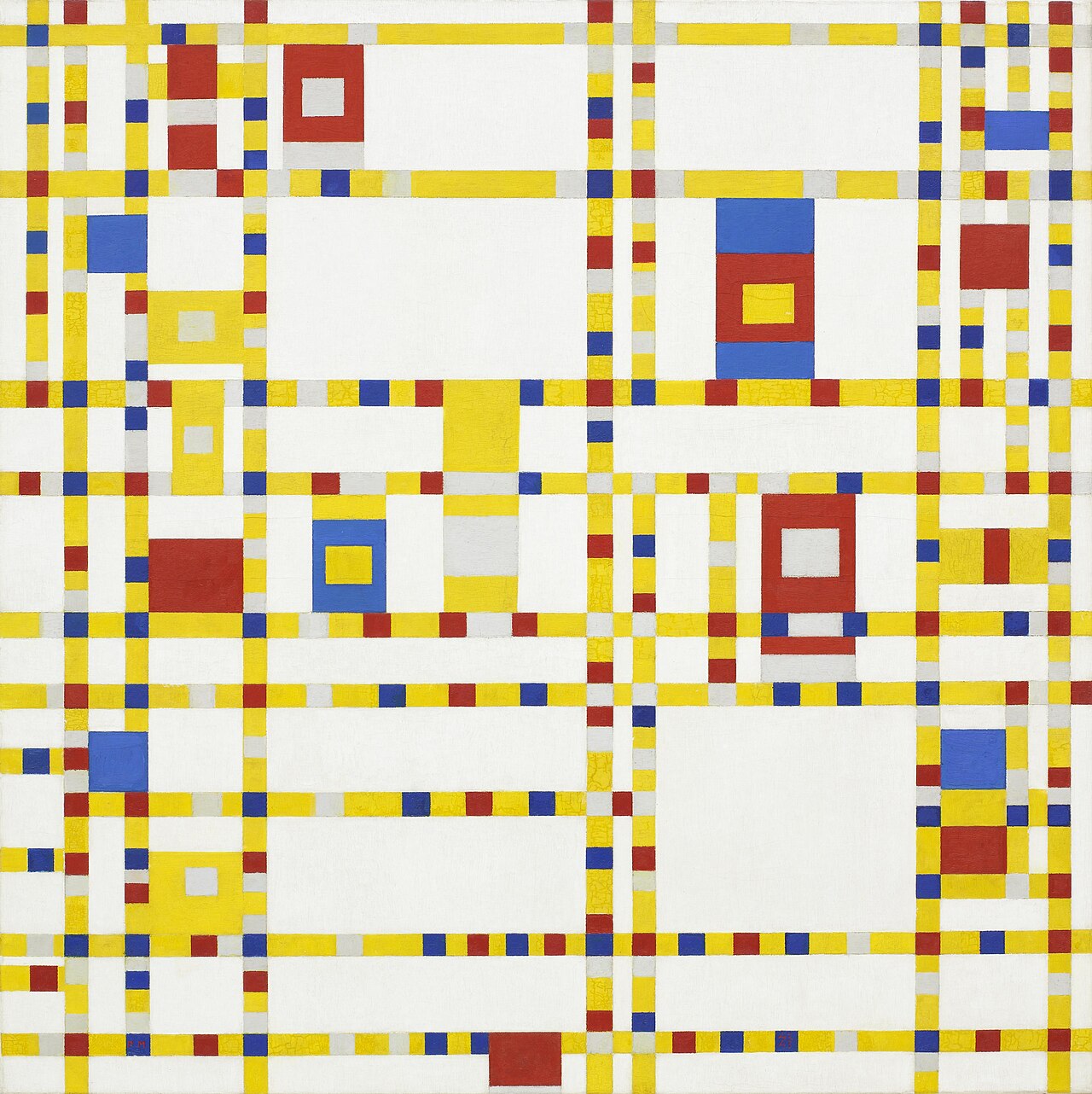

This is a painting by Mondrian.
He had spent years developing a very strict visual language: straight lines, right angles, and a limited set of colors.
Then, when he moved to New York, he became interested in boogie-woogie music and made this artwork.
What is interesting is that the grid is still there, but somehow it feels like it’s dancing.
The structure itself didn’t disappear. He was still working with constraints. But those constraints didn’t prevent him from creating something new.
Jazz seems to be similar. We have constraints such as chord progressions, scales, and rhythmic structures. We all work within them, but the music can still sound completely different.
I think science is similar too. We work with theories, mathematical tools, and existing methods. But no one will say that using them makes our work less creative. The interesting question would be what we actually do with those tools.
Two ways of learning a jazz solo
When jazz musicians practice improvisation, a common approach is to transcribe and copy solos by great players, like Charlie Parker, Bill Evans, Miles Davis, and so on. (Excuse me for not mentioning so many great artists. It is a random list that just occurred in my mind.)
I think this is a great way to learn. And if I had more time, I’d love to spend much more of it doing this myself.
But think about this: how do we learn from licks?
(1) Imagine someone who memorizes hundreds of phrases from Parker’s solos. They know exactly which phrase works over which chord progression. When they improvise, they can quickly play the right phrase at the right moment.
And they will sound FANTASTIC.
(2) Now imagine someone else who spends more time asking questions: like, Why did Parker choose this particular note? Why did Evans resolve the phrase here instead of there? Why did Miles Davis shift the rhythm in that way? What happens if I change the underlying harmony? Why did they use an alternate chord here? …
Instead of just memorizing phrases, this person tries to understand the ideas behind them and use those ideas to create something of their own.
Which one is the better jazz player?
The first person might actually give a much better performance. And if someone asks me whether the first person is a great performer, I would probably say yes.
But if someone asks whether that person is a great artist, I might think a little longer to be kind, but my gut makes me very reluctant to say yes.
I’m not saying memorizing phrases is wrong, or that using existing musical ideas makes someone less of an artist. In fact, you can learn a lot of musical structure just by copying…
And two musicians can play exactly the same notes but make completely different music through their timing, articulation, and interaction with the band (That is why jazz is fun!).
Still, I think there is a meaningful distinction here.
Being able to produce something good and understanding why it works are not necessarily the same ability.
And perhaps more importantly, understanding something and making your own creative decisions with it are not quite the same thing either.
What if we do the same thing in science?
Now let’s talk about doing research with AI.
Suppose I give an AI a research problem. It comes up with hypotheses, designs the experiments, writes the code, analyzes the results, and eventually produces a really good paper. Bam!
The results are correct, the experiments are convincing, and the paper makes a genuine contribution to science. Cannot deny.
That’s great. I don’t see any reason to depreciate the scientific value of the work just because AI produced it.
But what about ME?
If my contribution was simply reading the final paper and saying, “Hey, looks good, let’s submit,” would I feel like I had done science?
Probably not.
I might have produced a good paper. But I would have a hard time feeling that I was the scientist behind it.
On the other hand, suppose I use AI for almost all the coding, simulations, literature reviews, and even some of the theoretical derivations. But I am still actively thinking about the problem, questioning the assumptions, checking whether the conclusions make sense, and deciding what to investigate next.
That feels very different to me.
I don’t think being a scientist requires doing everything by hand. We’ve always relied on tools, collaborators, and accumulated knowledge.
What matters to me is whether I’m actually participating in the scientific reasoning and decision-making.
But understanding doesn’t guarantee better performance
I feel like this discourse is strong and important. Some people are even saying that relying on AI is the most efficient way to achieve the best performance.
We have assumed that someone who understands the underlying principles will perform better. But let’s be honest: that isn’t always true.
A jazz musician with an enormous vocabulary of memorized phrases might improvise better than someone who has spent years studying music theory.
Similarly, an AI might produce better scientific results than a human who has a much deeper understanding of a particular subject.
And remember our assumption: we’re imagining an AI that does understand the physics. Perhaps it even understands the physics better than we do. (But still, defning “understanding” seems like it needs more consensus)
So I don’t think understanding can be our final defense against AI.
We cannot just say, “Well, humans understand things, while AI only recognizes patterns.” Even if that were a useful distinction for some systems today, there’s no guarantee it will remain true.
Instead, I think we should separate two questions:
- Can you produce a good result?
- Can you explain, question, and make decisions about the principles behind that result?
These are surely different abilities. And I don’t think one always guarantees the other.
But even if AI eventually becomes excellent at both, the distinction is still useful when thinking about our own involvement in research.
Scientific Contribution
I’ve recently found myself thinking about what makes someone a “real scientist”.
For me, science isn’t just about generating correct answers.
It’s also about deciding which questions are worth asking. Being suspicious of an assumption that everyone else takes for granted. Recognizing that a beautiful theory might be wrong. Sometimes even deciding that the problem we’ve been trying to solve isn’t the right problem in the first place.
And there is a certain feeling of joy and awe; I still remember the moment when I learned the derivation of the wave equation from Maxwell equations; it was beautiful! Speaking of which, A book <Feynman’s Rainbow>, written by Leonard Mlodinow, gives a hint on this. Feynman once asked Leonard what inspired Descartes to study the rainbow mathematically. Mlodinow thought about it for a while and explained the physics and geometry of the rainbow, and how the problem could be understood by interpreting a single water droplet. But it was not the answer Feynman was looking for. He said, “I would say his inspiration was that he thought rainbows were beautiful.”
And importantly, I’m NOT claiming that AI will never be able to do these things.
Under our assumption, AI might be able to make all these decisions, perhaps better than I can.
But that doesn’t mean I have to stop making them myself.
I don’t need to be the smartest or most efficient problem solver in the room to participate meaningfully in science. Still, I can enjoy the process, find the beauty, and get inspired from what I have observed.
This is where my thinking has started to shift. Instead of asking, “What can I do that AI cannot?”, I want to ask, “What do I actually want to think about, understand, and create?”
That seems like a much more meaningful question to me.
What kind of researcher do I want to be?
I remember reading a LinkedIn post a while ago. Unfortunately, I don’t remember who wrote it, but the idea stayed with me.
It was something along the lines of: we don’t remember Michelangelo by counting how many sculptures he made. We remember David.
Of course, that’s a MUCH simplified way of talking about an artist’s career. But I like the message.
I don’t want to approach research as a game of producing as many papers as possible.
But I want to make something I can be genuinely proud of.
Something I spent time thinking about. Something that changed how I understand the world. Something I can explain and inspire other people to do something interesting.
And I don’t mean that research becomes more valuable just because I spent more hours on it. I would gladly use AI to save time on things that don’t require my attention. In fact, I already do, and I expect to use it in the future also.
But I don’t want to completely outsource the part I enjoy most: asking questions, being confused, trying to understand why something works, and realizing my stupidity or that I was asking the wrong question all along.
Maybe AI will eventually be better at all of those things too.
That’s fine.
I still want to be part of the process. It will still be fun and inspiring.
Going back to jazz, I don’t necessarily want to be the person who plays the most impressive solo every night.
I want to understand the music well enough to have something of my own to say.
And I think that’s also how I want to approach science.